The Lovable Paradox: AI Magic, Existential Dread, and a Hefty Price Tag
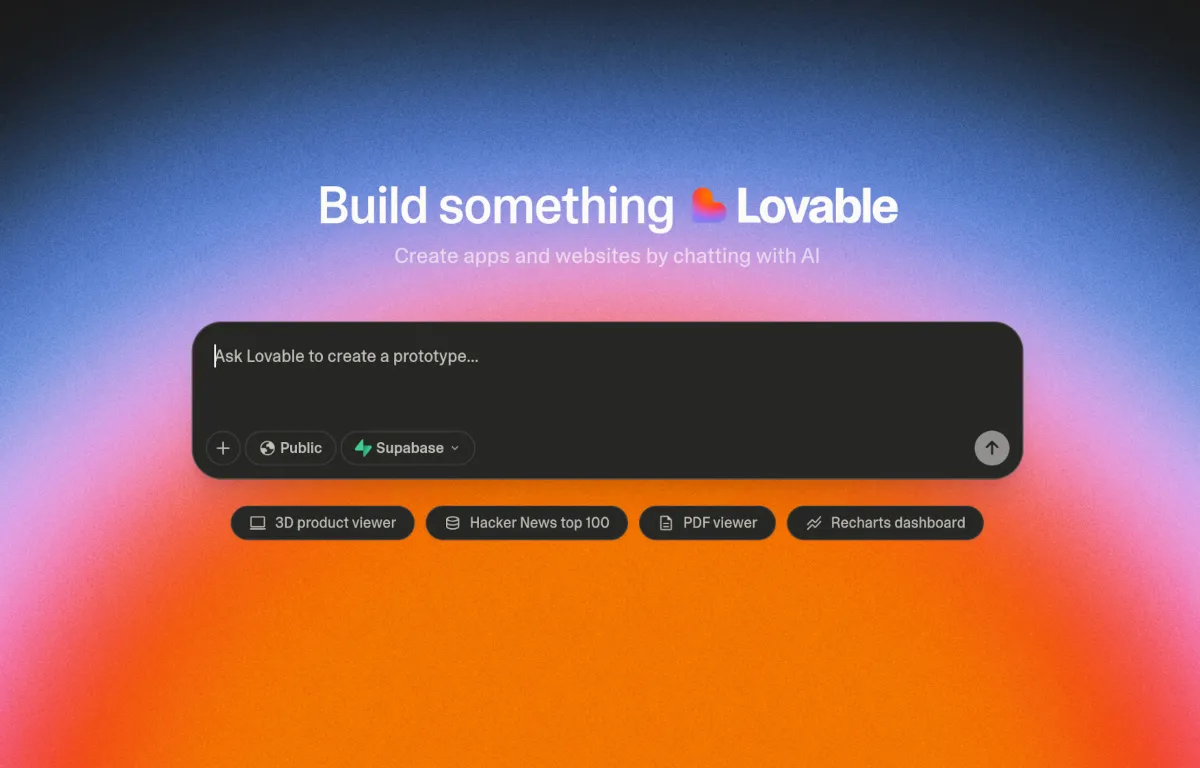
Just last week, I embarked on a deep dive into Lovable, an AI service that’s been making waves with its audacious claim of hitting $100M ARR. As a software developer, I was skeptical, but what followed was a rollercoaster of emotions, from initial disbelief to a touch of existential dread, before finally settling back on solid ground.
The “A-ha!” moment: rockets, stars, and one-click deployments
My skepticism began to crack almost immediately. With a single line of text, Lovable conjured up a super decently looking website about rockets and moon landings, complete with moving stars. It was impressive. And then, with just one click of a button, the entire website was deployed and live. The speed and ease were genuinely astonishing.
I pushed further, experimenting with multi-page applications, and even integrating with Supabase as a backend even though I did not specifically try this, seemed surprisingly feasible. The promise of building a full-fledged app this way seemed, for a moment, within reach.
The price of progress (and $100M ARR)
Then came the jolt back to reality: the pricing model. You get 5 “credits” to build your app, which translates to roughly 5 iterations. Beyond that, you’re immediately looking at a minimum of $25, and if you’re serious about getting your app off the ground, a commitment of at least $50 per month.
This is where the $100M ARR claim starts to make sense. It’s a pricing structure designed for rapid revenue generation. However, I have my suspicions about the true nature of that $100M figure. There’s a growing trend in the startup world to project one stellar month of subscription revenue to an entire year and calling that ARR. This is a far cry from actual ARR, and it doesn’t necessarily indicate a good business in the long run. It is very likely that many users pay the 50 dollars, build their app, decide that it is hard to get to life fully and drop off again after having spent days of their time and a significant amount of money to make it work.
On top of that, my hunch is that the cost of running these AI services is massive, and many AI products today are heavily subsidized by venture capital. We’re in the ” $5 Uber rides” period of AI. At some point, the true cost will need to be passed on to users, and I wonder if the current pricing model will hold up. The genius of Lovable’s approach, however, is that users will burn through AI tokens during the build phase, and then continue their subscriptions to keep their deployed apps online, which should help recoup those AI costs over time. Plus, the continued rapid drop in AI processing costs is a logical and rational bet. With all that being said this does not feel like an obvious home run to me, but also, it never really is and the most successful companies all looked like this at some point (to stick with Uber for example, they took almost 15 years to turn a profit and had already had an IPO at that point). It is simply part of the VC game.
The cracks in the facade: design limitations and missing URLs
Not everything was seamless. I tried to feed Lovable an already designed website, and the results were, frankly, terrible. It turned what was already a decently designed marketing website into a product developed that looked like it was developed by a person who had just read HTML for dummies and was trying creating a first website. It seems the magic works best when starting from a clean slate.
Another red flag for me is the lack of actual URLs from users showcasing their deployed Lovable projects on social media. Everyone on X (formerly Twitter) shares GIFs and screenshots, but never live links. This makes me suspicious. I suspect that getting from the initial impressive design to a truly functional, deployed app, even with a “deploy” button, still requires a significant amount of work that people vastly underestimate. Many of the examples might not really work as fully fledged applications, which is why they shy away from sharing a link. My guess it that if they would share this, it immediately becomes clear that the apps are non-functional and the story becomes way less interesting.
A software developer’s dilemma: black box deployments and mental laziness debt
As a programmer and architect, I thrive on knowing where my application runs, how it’s deployed, and what kind of traffic it can handle. With Lovable, this information is difficult to discover, making it challenging for serious companies to adopt it at scale (though this is something that can certainly improve with time).
However, I do see a strong use case for rapid prototyping. The fact that Lovable outputs React, Shadcn, and Tailwind code is a huge plus. This is highly feasible to integrate into real-life applications and would undoubtedly give developers a significant head start.
And no, I don’t believe frontend development or software development is dead. I think tools like Lovable will empower developers and designers alike to be significantly quicker and more efficient, freeing them to focus on more complex logic and user experience challenges. I do believe that they can also lead to “mental laziness debt.” The immediate convenience of having the AI do the heavy lifting means you might not fully understand how your application works. When things inevitably break, and they will, you’ll have to cash in that debt under pressure, and my intuition suggests it will be a lot harder to debug and fix. You will literally need to read up on your own application’s inner workings before you can even start attempting fixing it. The question is, is that a trade-off worth making for the initial speed boost? Only time will tell.
Overall impression: impressive, flawed, and full of potential
Despite its current flaws, I am genuinely impressed by Lovable. It’s a very well-executed product with immense potential to improve over time. And it’s particularly exciting to see a European company making such bold strides in the AI space. We need more of them!
Whether you can build a complete SaaS business around an app made with Lovable remains to be seen. If you even want to have a SaaS business in the traditional sense, remains to be seen. Whether this over time will empower non-technical users to build apps or empower technical users to be a lot more effective, or neither, remains to be seen. The long-term viability is still unclear. Still, impressive work so far.